

NewsDetails
CNC Machined Pipe Fittings for Industrial Applications | Precision Manufacturing
author:Kiyama time:2026-06-11 16:09:28 Click:99
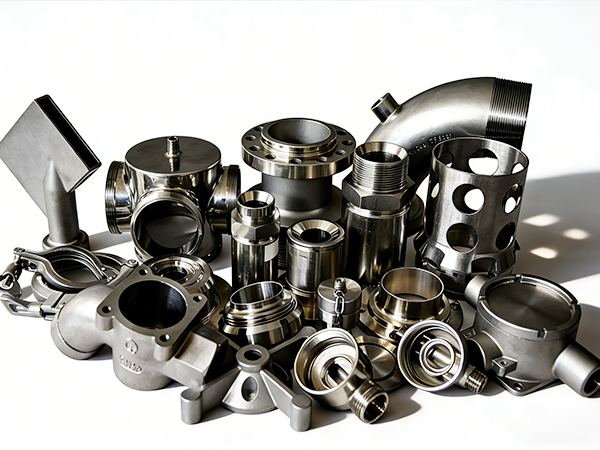
Modern industrial operations demand pipe fittings that meet extraordinarily precise specifications. CNC machining fulfills these requirements, producing components with tolerances measured in thousandths of an inch. From chemical processing plants to food and beverage facilities to automotive assembly lines, precision-machined fittings enable reliable system performance under challenging conditions.
.jpg)
The Role of CNC Machining in Fitting Production
Computer numerical control machining transforms raw materials into precision components through programmed tool paths. Multi-axis CNC lathes rotate workpieces while cutting tools remove material with extreme accuracy. This automated approach eliminates the variability inherent in manual machining operations.
Modern machining centers operate with positional accuracies of ±0.0002 inches and repeatabilities below ±0.0001 inches. Such precision ensures consistent fitting dimensions across production runs, enabling interchangeability that simplifies maintenance and reduces inventory requirements.
A well-equipped factory stocks various CNC equipment including turning centers, milling centers, and turn-mill combinations. This equipment diversity handles diverse fitting configurations—straight couplings, elbows, tees, reducers, and custom geometries—all within single setups when possible.
Chemical Processing Applications
Chemical processing facilities expose pipe fittings to aggressive corrosives, elevated temperatures, and thermal cycling. The industry specifies numerous exotic alloys including 316L, 904L, and various super-duplex compositions. CNC machining precisely forms these difficult-to-machine materials without compromising material properties.
Tolerances in chemical service prove particularly critical. Gasket surfaces must maintain flatness within 0.002 inches to ensure leak-free joints. Threaded connections require precise taper and pitch diameters that only CNC machining reliably achieves. The slightest deviation creates leak paths that endanger personnel and the environment.
Manufacturers serving chemical processing maintain material testing programs that verify alloy composition and corrosion resistance. PMI testing confirms material authenticity before shipment. Documentation meets the traceability requirements that regulatory agencies impose.
The food and beverage industry operates under stringent hygiene regulations that affect fitting specifications. Fittings must feature smooth surfaces that prevent bacterial accumulation—typically Ra 32 microinches or better on product contact surfaces. CNC machining consistently achieves these surface requirements without labor-intensive hand finishing.
Sanitary fittings avoid crevices and dead spaces where contaminants collect. CNC programming generates smooth transitions and radii that facilitate clean-in-place procedures. Materials reflect the application's corrosion concerns—high-chloride environments in food processing require type 316L stainless steel minimum.
Automotive Manufacturing Applications
Automotive production facilities employ pipe fittings in numerous fluid systems—lubrication, cooling, fuel, and pneumatic controls. Production volumes demand fittings that assemble quickly and reliably without adjustment or reworking. CNC machining provides the consistency that automated assembly lines require.
Fit-up accuracy proves essential in automotive applications. Misalignment during assembly slows production lines and increases warranty costs. Precise dimensions ensure proper engagement of threaded connections and correct O-ring sealing for compression fittings. Statistical process control maintains the capability indices that automotive customers specify.
Just-in-time delivery arrangements tie fitting deliveries tightly to production schedules. CNC programming flexibility enables quick changeovers between fitting types. A capable supplier maintains the production capacity and scheduling systems that automotive supply chains demand.
Tolerance Specifications and Standards
Industrial fitting manufacturing follows dimensional standards established by ASME, ASTM, and MSS. The Manufacturer's Standardization Society publishes SP-83, specifying dimensional requirements for factory-made wrought butt welding fittings. These standards define critical dimensions that CNC programs incorporate.
Thread specifications require particular attention. NPT threads per ASME B1.20.1 define strict tolerances on pitch diameter, thread angle, and taper. CNC threading operations maintain these tolerances through consistent tool geometry and temperature compensation. Gaging confirms every thread parameter meets specification.
Flat-faced fitting flanges face parallel to within 0.002 inches across the sealing surface. Concentricity between bolt circles and flange faces stays within 0.010 inches. These tight tolerances prevent flange stress and gasket leakage under pressure.
Quality Assurance Through Inspection
CMC machining inspection employs coordinate measuring machines that capture three-dimensional measurements with exceptional precision. These measurement systems compare fitted dimensions against CAD models, generating detailed inspection reports that document conformance.
Statistical process control tracks machining capability over time. Capability indices—Cp and Cpk values—quantify the manufacturer's ability to hold tolerances consistently. Values exceeding 1.33 indicate processes capable of meeting the six-sigma quality levels that demanding applications require.
Documentation practices vary among suppliers. Best-in-class manufacturers provide complete inspection records with every shipment—including first article inspection reports, in-process measurements, and final inspection data. Traceability to manufacturing records enables failure analysis when field issues emerge.
Choosing Precision-Machined Fittings
Applications involving hazardous materials, high pressures, or critical reliability demand the precision that CNC-machined fittings provide. The higher initial cost compares favorably against potential failure consequences—environmental releases, production losses, and safety incidents carry far greater expense than quality fitting investments.
Suppliers offering CNC-machined fittings demonstrate manufacturing sophistication that benefits buyers in countless ways. Consistent quality reduces incoming inspection burdens. Reliable deliveries simplify production planning. Comprehensive documentation satisfies auditors and regulators. Partner with suppliers whose capabilities match application criticality.
References
Todd, R. H., Allen, D. K., & Alting, L. (1994). Manufacturing Processes Reference Guide. Industrial Press Inc.
ASM International. (2007). Machining: Vol. 16. ASM Handbook Series. ASM International.
ASME B1.20.1-2013: Pipe Threads, General Purpose, Inch. The American Society of Mechanical Engineers.
Krar, S. F., & Oswald, J. W. (2014). Technology of Machine Tools. McGraw-Hill Education.
 Recommended Products
.jpg)
.jpg)
.jpg)
.jpg)
.jpg) Contact us
Contact us
—— Contact:Mr. Meng
—— Tel:+86 18233783692
—— Email:mengfy001@gmail.com
—— Url:https://www.kiyama-pipefitting.com
—— Address:Cangzhou Economic and Technological Development Zone, Cangzhou City, Hebei Province, China